

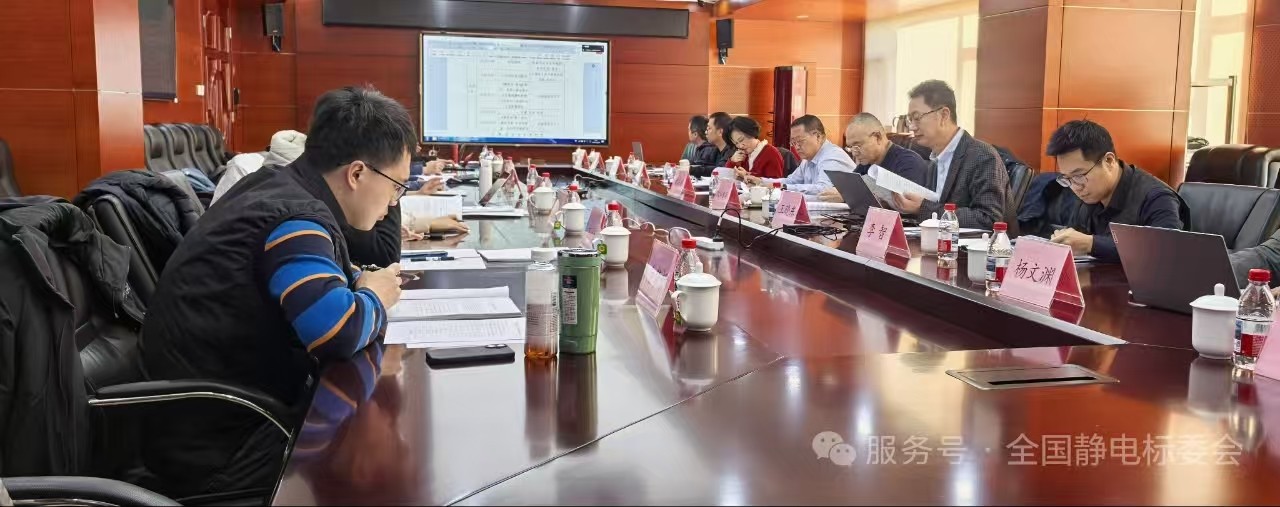
On November 19, 2025, the review meeting for the draft versions of two National Standardization Guiding Technical Documents—"Electrostatics - Part 6-2: Electrostatic control in healthcare,
commercial and public areas - Public and office areas" and "Electrostatics - Part 1: Electrostatic phenomena - Principles and measurements"—was held in Beijing. The meeting was organized
by the National Technical Committee for Electrostatic Standardization and hosted by the Urban Safety and Environmental Science Research Institute of the Beijing Academy of Science and Technology.
Nearly 20 experts and representatives from organizations including Sinopec Safety Engineering Research Institute Co., Ltd., Beijing Institute of Technology, the Fifth Electronics Research Institute
of the Ministry of Industry and Information Technology, the Electromagnetic Environment Effects Key Laboratory of the Army Engineering University (Shijiazhuang Campus), the Urban Safety and
Environmental Science Research Institute of the Beijing Academy of Science and Technology, China Ordnance Industry Gunpowder and Safety Technology Research Institute, University of Science
and Technology Beijing, East China University of Science and Technology, Beihang University, Jiangsu Tuor Testing Co., Ltd., Beijing Zhenxing Metrology and Testing Research Institute, China Home
Electric Appliance Research Institute (Beijing) Testing & Certification Co., Ltd., Shijiazhuang Tiedao University, the National Technical Committee for Standardization Principles and Methods, and
the China Electronics Standardization Institute attended the meeting in person. Representatives from multiple other organizations participated online.
During the meeting, experts conducted a thorough review and provided technical guidance on the draft versions of the two National Standardization Guiding Technical Documents, further enhancing
the quality and scientific rationality of the documents. The drafting group will revise and improve the documents based on the discussion and feedback received. It is expected that the drafts will soon
be officially released to the public for broader consultation, with the aim of building social consensus and ensuring the scientific nature, applicability, and advancement of the standards.


